




2020
Mr. Samir Somaiya in a conversation with ChiniMandi News expressed views on the Indian sugar industry and way forward
CHINIMANDI NEWS | Aug 19, 2020
The Indian sugar millers have been reeling from various crises like unsold sugar stocks, cane dues, unpaid interests etc. Coronavirus pandemic has also aggravated the crisis exponentially by hitting the sugar industry in terms of trends in feasibility of performance, production capacity, consumer market or precisely every factor that is incorporated to make this wheel from farmer to consumer run smoothly. A bailout package seems to be the only favorable solution demanded by the sugar millers at present.
In a conversation with ChiniMandi News, Mr.Samir Somaiya – Chairman & Managing Director at Godavari Biorefineries Ltd. expressed his views on the current scenario of the Indian sugar industry and way forward.
Speaking on the steps the Government should take in order to bailout the industry from crisis. He said, “The Government is already taking steps in the right direction to help the industry and also see the industry as a growth engine. India has proven itself to be a surplus producer of sugarcane. This sugarcane surplus has to be seen as a resource to meet our food and energy needs. The Government realizes this and has announced a bold policy to encourage the use of sugarcane juice/syrup and B Heavy molasses to ethanol. This will be used for ethanol blending with petrol to meet the energy security of the country. The Government is also encouraging the making of 2G ethanol (from cellulose) and Bio-CNG. These are far reaching changes and will transform the face of the industry and indeed the rural economy. But this process takes time. Sugar companies will need to get regulatory approvals and finance to build these distillation assets. Until then, the surplus sugar will have to be exported.”
“The Government has also announced good policies for the export of this sugar. In the current season, India has exported almost 6 million tons of sugar, the highest ever. We are hoping that the Government of India announces a similar policy for the coming season, so that the Indian sugar once again finds its way in the global market.
The Government should also make sure that the price of sugar and ethanol are remunerative in proportion to the price of cane. Currently, the Indian sugarcane prices as a function of sugar price are among the highest in the world. We understand that the farmer needs a remunerative price, but in that case, the sugar or ethanol price must be raised accordingly. With these policy changes, the Indian sugarcane industry will again be a sunshine industry.” He added.
Commenting on demand, supply dynamics play in the upcoming season considering the after effects of the outbreak of Covid-19 Mr. Somaiya said, “There is definitely a slowdown in the sale of sugar. With much of the economy slowly emerging from the lockdown, we hope that the demand picks up as well. The Government is likely to fix a minimum selling price of sugar of Rs. 33 per kg. We expect the price of sugar to be above this level.”
Sharing his views on what measures Indian sugar industry should take to step up for the ethanol production programme and also how his organization is taking steps to be exemplary for the Indian sugar industry in building a sustainable bio-fuel economy he shared, “The millers must quickly apply for regulatory and financial approvals and take steps to divert their sugar surplus to ethanol.
Godavari Biorefineries Limited is very keen on supporting the Government of India’s bio-fuel economy programme. We expanded our distillery from 200,000 lpd to 320,000 lpd in the last season. For the coming season, we are expanding our distillery capacity to 400,000 lpd. Like many sugar companies in Brazil, we have created optionality in choosing between sugar and ethanol. In the coming year, we will be making ethanol via sugarcane syrup and B Heavy molasses. We expect to divert over 40% of our sugars to make ethanol. As a company, we are also keen on working on 2G ethanol, and Bio-CNG policies that the Government is actively promoting. We have also pioneered the use of renewable feedstocks to make a variety of chemicals, materials and renewable power finding applications in pharmaceuticals, agriculture, flavours and fragrances coatings, and more. We are also working with farmers to help them intercrop and improve their agronomy so that they farm and earn better.”
Being asked, knowing that India can be the largest ethanol producer in the world, what long term policies should the Government take for the industry to develop looking at the current scenario and what immediate measures may be required in making the dynamics of demand supply play well Mr. Somaiya said, “Brazil and the USA are very large players in ethanol in the world, and to get to those levels, India will need a wide variety of renewable biomass. But, the Government is already trying to increase the blending percentage and has made bold targets to move towards a 20% blend rate. I think promoting flex fuel cars like in Brazil would be a next step to further encourage higher adoption. And in states that are already ethanol surplus, the blend rate can be increased quicker.”
Transition to Specialty chemicals
Chemical Engineering World | Jul 01, 2020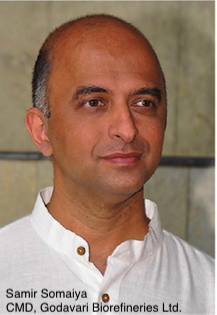
How is the market for green / renewable chemicals evolving globally and in India?
We see a big increase in the need for renewable/green chemicals. This trend is more visible globally. Large international companies are making public commitments to us renewable chemicals, biodegradable packaging, carbon neutral processes, and making a more sensitive approach to people, climate and the planet going forward. In this, there is a huge opportunity for companies in the renewable space to go forward.
To what extent renewable chemicals can replace the conventional chemicals and petrochemicals in India and what are the major concerns that will have to be addressed at various levels in India?
Renewable chemicals can be used in various ways and can be ‘Identical’ except that these are made from renewable sources. For example, one can make acetic acid from renewable sources that is made otherwise from petroleum feedstock. ‘Drop-ins’, and can completely substitute conventional materials; although they may be chemically different, with no loss of functionality. Green chemicals can also be completely different from material derived from conventional feedstock and have different properties but still may have the same end use. Some of the renewable chemicals may not have a fossil substitute.
In each of these cases, the substitution will depend upon many factors. One of the very first point is if the price of the renewable chemical can compete with that derived from fossil sources. Second, whether the end use segment is willing to pay a price premium for a renewable derived feedstock. We find that this is often the case in the skin care sector. In such cases, responsibly sourced, traceable, renewable and/or biodegradable chemicals can command a price premium from the end customer. Third point is whether the material properties can help command a better price. Finally, in some markets, the Governments are creating policies that promote the use of renewable raw materials. Since your question particularly concerned India. In my opinion, bio-ethanol is a ‘Drop-in’ and there is a favorable Government policy to help encourage that blend to help our energy security and a lower carbon future. For chemicals, the market needs to mature to give us more value. But I think that consumer preferences are changing, and there are niche markets that reward use of such chemicals, and it is a matter of time before some end use segments grow the use of these feedstocks.
How friendly are the policies in our country to support the growth of renewable chemicals and protect the domestic industry from imports?
In India, there are no policies for renewable chemicals. The Government has created policies for renewable fuel (ethanol blending), and also Bio-CNG. However, this support is not extended to the chemical sector. In the EU and the USA, there are significant policies encouraging the investment in research, pilot plant, and commercialization of renewable processes and technologies. Further, there are policies in place to influence the attractiveness of these products. The US Bio-Preferred Program is one such example. The Carbon markets are also another way to help the economic viability of such initiatives.
Tell us about the Godavari bio-refinery model and how has the organization continued to stay financially viable? How have you addressed the cost challenge across the customers in India though these lead to higher ROIs across for the user industries?
Godavari Biorefineries is using four strategies for the future. The Government has encouraged the making of ethanol from sugarcane juice or syrup for blending in petrol for our transportation needs. Godavari was one of the first companies to aggressively adapt to this environment and supplied a large quantity of ethanol for the purpose this past year. This provides us much needed optionality to swing between ethanol and sugar based on the demand supply gap in sugar or ethanol. Currently, we are increasing our ethanol capacity to 400,000 lpd. With this we will have a capacity of over 100 million litres of ethyl alcohol in a single location. In the chemical sector, we are making a transition to specialty chemicals. In the past few years, we have successfully introduced new chemicals that are in the fragrance or skin care field. We are also establishing more long term relationships with global companies that share our vision of a sustainable future, so that we can jointly develop products with their involvement. This ‘joint’ development approach helps us know the target product cost and quality of the customer. Achieving the same helps them achieve their ROIs. Bio-refining means products from agriculture and we work closely with the farmer to help enhance yields and productivity, in order for the farmer to be financially better off, and the farm and soil to be healthy. To promote well grown and well processed foods, we have established a brand ‘Jivana’ to promote pure and high quality food products that we need on a daily basis.
When & why did your organization stop producing acetic acid and took the decision to restart the business on demand in October 2018 which received USDA certification in next few months?
We stopped making Acetic Acid over a decade ago. In this case, we made the same chemical from renewable sources (ethanol) that is also made from fossil resources. With the reduction in import duties, the entire Indian alcohol based chemical industry that made acetic acid from ethanol found itself unable to compete with petroleum sources. Along with all the others, we too shut down. We reinvested and resumed the manufacture of acetic acid only on a very small scale. There are a few customers the world over desire to buy this product because their end market segment is ready to pay a premium for the same. This is a small market and the demand fluctuates. But we are hopeful that the market will grow.
Which is the best suited bio refinery model for India to realize the sustainability goal? How can we build world class bio refineries in our country?
I hope we are working on demonstrating that. It is a model that works closely with farmers. In India, farmers have small land holdings. Any engagement has to help them be financially sustainable and for the farm to be productive in the short and longer term. We are working with our farmers to reduce their water footprint, and encourage the use of intercrops to reduce fertilizer use and give them a dual income. Similarly, biorefining is the process of converting the feedstock into value added products. These find applications in foods, fuels, electricity, chemicals, pharmaceuticals, fragrance chemistry, bio materials, agrochemicals and much more. There has to be a thinking towards a circular and cascading biorefinery that continuously strives to find and add value. A few years ago, we installed an incinerator boiler to recover energy from our waste. Now, we are implementing a process to extract potash from the ash from the incinerator. This potash will then be sold to our farmers. Currently, India imports almost all its potash needs. Through this example, we are showing how we can cascade and add value, and the process is circular. As a country, we need research to keep imagining the future. Research and practice go hand in hand. In Europe, I have seen large pilot plants where lab work can be taken further. We need to have such facilities to further bio-refining in India.
How supportive is the National Biofuels Policy towards setting up 2nd generation bio-refineries and what are the challenges that still need to be addressed?
The National Biofuel policy helps the making of biofuels. India is an agrarian economy and has an abundance of biomass. However, the collection of the biomass will always be a challenge. So the availability of this biomass at the processing site is an entry barrier. At Godavari Biorefineries, we have invested much in energy efficiency and engineering to make available surplus bagasse on site for use as a next generation feedstock. Secondly, ethanol from biomass is what is called 2-G (2nd generation). These are possible, and we are seeing demonstration facilities around the world. However, these are expensive and are made possible with Government support and subsidy. The Government of India is also supporting the creation of such Greenfield facilities to make 2G ethanol. But as in every other location, these facilities are very expensive. The Government makes them possible with ‘Viability Gap Funding’. I believe that India should also experiment with our own model. We need to encourage ‘bolt on’ solutions of adding equipment and technology to existing infrastructure. For example, our sugar mills already have biomass on site and downstream ethanol facilities. A ‘bolt on’ approach will only add what is necessary to complete the 2G addition, reducing funding needs. The current biofuel policy provides for viability gap funding only for Greenfield facilities. It needs to be modified for ‘bolt on’ facilities as well. In summary, I think India has a great agriculture base. There is lots of biomass and we have the education and research system to dream. The market is large and people are imagining a better and more sustainable future for their children. Biorefining of biomass is the way for a more sustainable way of life.
Godavari Biorefineries Limited contributes to Ethanol Blending Program by pioneering the use of sugarcane syrup for making ethanol
Aug 10, 2020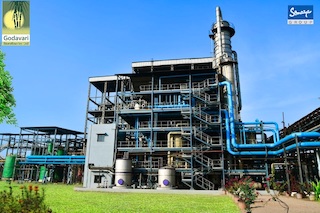
On the occasion of “World Biofuel Day”, we are happy to share that Godavari Biorefineries Ltd. has delivered 38 million litres of ethanol to the Ethanol Blending Programme (EBP) of the Government of India. Of these, 35 million litres was derived from Sugarcane syrup and B Heavy molasses. Godavari Biorefineries pioneered the use of sugarcane syrup for making ethanol by diverting more than 30% of sugarcane directly following the Brazilian model.
Godavari Biorefineries Ltd. manufactured the ethanol in its distillery with a production capacity of 320,000 litres per day. In the coming season, we will be expanding the distillery to manufacture 400,000 litres per day of ethanol. We aim to deliver more than 70 million litres of ethanol to the blending programme during the next sugar season.
Godavari Biorefineries Limited achieves Bonsucro Certification
Apr 27, 2020
Godavari Biorefineries Limited (GBL) has earned Bonsucro certification for the Sameerwadi manufacturing unit located in the state of Karnataka, India.
GBL has demonstrated the operation of a management system that is compliant with the requirements of Bonsucro standards, such as Bonsucro Production standard, Bonsucro Mass Balance Chain of Custody Standard and the Bonsucro Smallholder Production Standard. Bonsucro certification allows GBL to assure the customers of getting catered in an environmentally and socially responsible manner.
Bonsucro is a global multi-stakeholder non-profit organization that exists to promote sustainable sugarcane production, processing, and trade around the world. Bonsucro supports a community of over 280 members in over 50 countries, from all elements of the sugarcane supply chain, including, farmers, millers, traders, buyers, and support organizations. Bonsucro is a full member of ISEAL Alliance, the global membership association for credible sustainability standards, and complies with all of ISEAL’s Codes of Good Practice, which provide a globally recognized framework used by leading sustainability standards.
To learn more about the Bonsucro certification please visit http://www.bonsucro.com/
Contact: Godavari Biorefineries Ltd.
Mr. Karan Mengar
91-22-61702100
mengar.karan@somaiya.com
Godavari Biorefineries Limited Launches PAAVAN™ - Ethanol Based Hand Sanitizer
Mar 24, 2020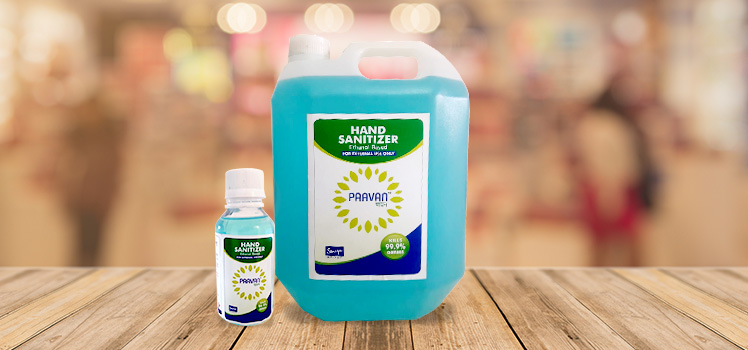
We at GBL, are happy to share that our Ethanol-based hand sanitizer, PAAVAN™, has been approved and licensed by the FDA. We have started manufacturing it at our Karnataka and Maharashtra Units. PAAVAN™ is a non-sticky hand sanitizer that immediately cleanses hands without water & soap providing effective protection against a variety of bacteria, fungi, and viruses. With the COVID-19 virus threat looming globally, PAAVAN™ will assist in safeguarding public health. PAAVAN™ is available in 500 ml Bottle, 5 Ltr Jerry Can, 35 Ltr Jerry Can & 200 Ltr HDPE Drum.

